

Weights and Measures Day is celebrated on 20th May 2023 and was first celebrated in 1875 as a convention that was signed on this day to help solve various problems relating to weights and measures, not only in the United States but globally.
Supermarkets have announced an initiative on price cuts this week, yet many items have soared in price above and beyond the quoted rate of inflation. Those on low and fixed incomes like pensioners are hardest hit, with budget lines seeing the largest price hikes.

Which? recently took a look at some of the best supermarket alternatives to the big brands and gave comparisons on Heinz Cream of Tomato soup (£1.70 for a 400g tin) -v- Sainsbury’s own brand (57p for a 400g tin) and Aldi’s own brand pepperoni pizza at £1.25.
Aldi increased the price within days by 14p to £1.39 (a 11% increase) and Sainsbury’s increased the tins of own brand soup from 57p to 75p (a 31% increase) recently. I buy these products so I know this.
Supermarkets have now introduced two-tier pricing for those with and without loyalty cards on single and multiple buys, meaning that consumers cannot easily make comparisons to get the best price.
Shrinkflation is accelerating at an alarming rate. As inflation has hit the highest level in 40 years, the cost-of-living crisis has been hitting households hard.
Uncle Ben’s rice has cut the size of rice portions from 250g to 220g (12% increase).
This insidious inflation is a double whammy and consumers are being ripped off, with many not realising the impact it has on their finances.
Consumers don’t have the time to perform various calculations and parents cannot be expected to when they have children with them during their shop.
Here are 6 ways you can use weights and measures to save money on your food shop
1. Compare single items to bulk buys on your favourite groceries
Sainsbury’s sell their own brand Cream of Tomato soup for 75p a tin and packs of 4 for £2.10 (52.5p each). This is a saving of 43% on each tin.
Look for other similar savings on your favourite groceries and bulk buy wherever possible.
Consider bulk buying with neighbours and friends at outlets such as Costco and split the savings.
2. Use your loyalty cards
Supermarkets have introduced two-tier pricing, meaning that many popular items are heavily discounted as introductory offers.
Loyalty cards also help you rack up points, which can be saved and put towards your Christmas shopping.
3. Compare like with like
Loose items like ginger are usually priced per kg, whereas ginger in plastic packaging may be priced per 100g.
If ginger is priced at 85p per 100g, that is £8.50 per kg – a 70% price hike.
Supermarkets play these tricks on consumers with items that generally do not cost much as a single purchase, knowing that consumers will see it as a trivial amount.
Remember the old adage, “Look after the pennies and the pounds look after themselves”.
4. Eye-level is buy-level
Food manufacturers pay supermarkets a premium for product placement.
Studies suggest we scan shelf space from left or right. Premium brands and those with the highest profit margins will be placed at eye-level.
Common items such as tins of chopped tomatoes, spaghetti hoops and baked beans will be arranged with the cheapest items placed below eye level to induce you to buy the more expensive equivalents.
Aim for the bottom shelf. You will find similar branded products at a much lower price.
5. Compare prices online
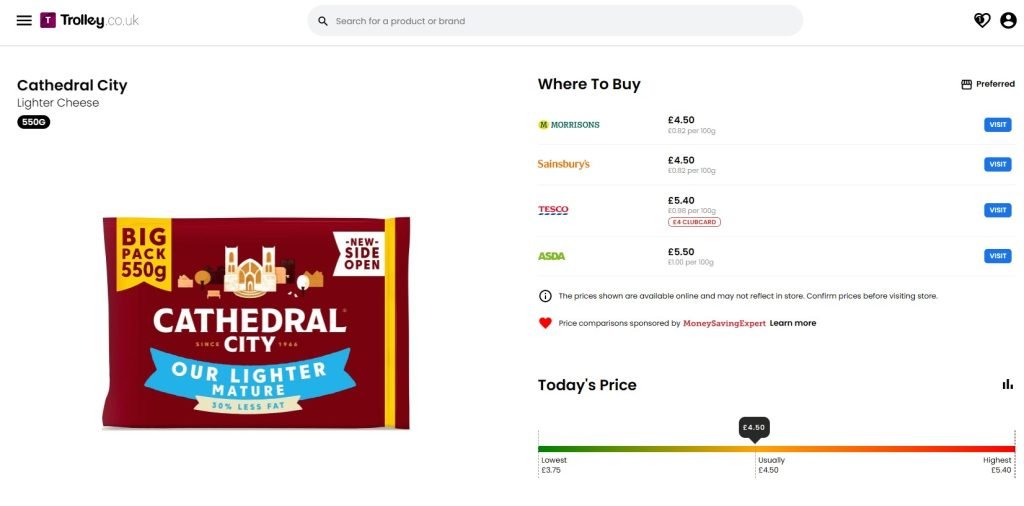
The website www.trolley.co.uk gives you the best prices for groceries across all of the major supermarkets.
The price ranges can be vast.
Cathedral City Lighter Cheese 550g ranges from £4 with a Tesco Clubcard to £5.50 at Asda.
Sensodyne toothpaste 75ml is cheapest at Boots (£1.60) and is £2.50 at Asda and Tesco.
These price comparisons were made on 17th May 2023 on www.trolley.co.uk

Consumers don’t have time to pick and choose items from various stores and it wouldn’t be cost effective to do so. Nevertheless, it pays to shop around and plan your shopping trips.
6. Make a meal plan and a shopping list
Money Helper research found 60% of consumers who take a shopping list to the supermarket say it saves them money on their food shop.
Use www.trolley.co.uk to get the best prices for your food shop, make a list, get the best deals and avoid impulse buying.
We are doing more shopping online than ever before, so shopping safely to avoid fraud and scams is paramount.
What are your top tips to save money on your food shop? Do you think supermarkets can do more to help cash-strapped consumers?
