

Today is National Pothole Day (15/01/2024). The day is marked by raising awareness of potholes and the risks they pose to all road users, particularly cyclists, and to report them.
Is there anything more annoying than driving down the road and having to dodge potholes? It’s even worse at this time of year when potholes are full of water and driving in long, dark nights.
Potholes are a constant annoyance to motorists and road users everywhere. National Pothole Day is your opportunity to do something about those potholes.
History of National Pothole Day
Every day there seems to be a new pothole forming on the roads and they make your journey increasingly treacherous.

Potholes are nothing new. Their name comes from the Roman roads built back in the days of the Roman Empire. In those days roads were built on a bed of clay, topped with gravel, and once again topped by hard-baked bricks.
Potholes were where potters would break open the road’s surface to get at the good potting clay found underneath.
This was a great source of clay for the potters and a miserable source of inconvenience for the chariots and wagons that travelled those roads. National Pothole day reminds us of their long history, and our responsibility to help get them repaired for all road users.
Soaring pothole insurance claims
Admiral Insurance recorded 1,324 pothole-related claims in 2023, which is up 40% compared with 946 claims in 2022.
Average cost of pothole-related repairs increased by 29% in 2023 to £3,070 compared with £2,378 in 2022.
Admiral cited an increase in the cost of repairs and vehicles with expensive technology were to blame for the soaring bills.
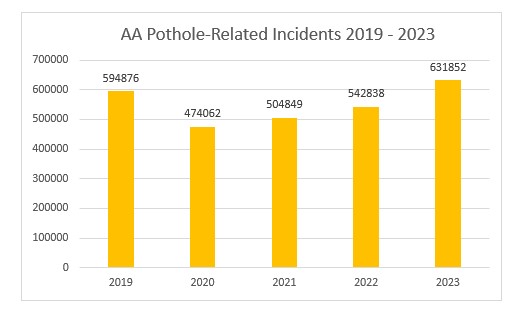
The AA reported in October that pothole breakdowns had hit a five-year high, and were on track to attend over 613,000 pothole related breakdowns in 2023.
The AA dealt with 631,852 incidents in 2023 of tyre, wheel, steering, and suspension damaged by potholes which if rounded up on a national scale represents a staggering 2m vehicles affected by poor road maintenance. This is an increase of 16.39% when compared to 2022 (542,838). As most new cars don’t come with a spare tyre as standard, pothole punctures are costing drivers more time and money.
Last month (62k) saw an increase of 15.2% when compared to December 2022 (54k).
Pothole Partnership
A new partnership has been launched today (15 January) between road users and industry to help tackle the scourge of potholes as shock new figures from the AA show pothole damage to vehicles has hit a five year high.
Now the newly-formed Pothole Partnership has unveiled a new five-point plan to help tackle the issue. The coalition represents the interests of drivers, motorcyclists, cyclists, pedestrians, and road repairers. The Partnership’s Pothole pledge is being sent to central and local government today.
The Pothole Partnership has been formed by the AA, the National Motorcyclists Council, British Cycling, IAM RoadSmart, the British Motorcyclists Federation and manufacturer JCB.
Pothole damage to vehicles cost a staggering £474,000,000 last year, according to new figures released by the Pothole Partnership on National Pothole Day.

The costs are likely to be much higher for many motorists. Admiral Insurance data revealed the average cost of a pothole claim was up 29% in 12 months from £2,378 to over £3,000.
HMRC pocketed at least £79m in VAT based on AA pothole damage costs.
Such is the widespread concern over potholes that a new Pothole Partnership of road users (drivers, motorcycle riders and cyclists) and repairers has been formed to press the case for more effective permanent repairs.
Edmund King, AA President, said: “Last year AA patrols dealt with more than 600,000 pothole-related incidents which on a national scale will have cost drivers almost half a billion pounds. Currently, we often have a vicious circle of: pothole formed; damage caused; pothole patched; pothole reappears with more damage caused – when what we need are more permanent repairs. Potholes are the number one concern for 96% of drivers and can be fatal for those on two wheels so hopefully pressure from the Pothole Partnership will lead to permanent repairs.”
Craig Carey-Clinch, Executive Director, National Motorcyclists Council, said: “The situation is becoming ever more acute for motorcyclists. Potholes and other road surface related defects are already shown to be extremely dangerous for motorcycle riders. The same pothole that damages a car, could prove fatal to a rider. Action is needed now to urgently clear the backlog of repairs. The NMC fully supports the Pothole Partnership and urges the Government to front load the £8.3billion that has been announced. The problem is now, not in seven or nine years time.”
Pothole Pledge

Permanent: Local authorities to limit the practice of temporary pothole repairs or patches and, where possible, every pothole or patch to be repaired permanently.
Precise: All local authorities / contractors to adhere to UK-wide repair and inspection standards, and report annually on the repairs undertaken.
Price: Government to demonstrate greater urgency by accelerating and increasing spending of the £8.3bn pothole funding for England in the first three years – with total clarity on the distribution to local authorities.
Provision: Central and local government to guarantee ringfencing of ALL road maintenance funding to help deliver innovations that enable permanent repairs.
Progress: Full transparency from local authorities on their roads repair backlog, categorised by potholes, patching works and road resurfacing.
The Partnership has welcomed extra funding for maintenance including the £8.3bn from HS2 but wants it ring-fenced and expenditure increased in the early years and used more effectively. It is often a false economy to just patch potholes when that stretch of road needs resurfacing. New technology in the shape of the JCB Pothole Pro can not only speed up repairs, but also make them last longer.
A recent survey of more than 11,000 AA members found that the top transport issue for 96% of drivers was Increased investment in repairing and upgrading the roads (i.e., fixing potholes).** Whilst potholes can be a very expensive inconvenience for those on four wheels, it can be life-changing and even fatal for those on two wheels.
Pothole funding
Prime Minister Rishi Sunak has pledged to tackle “the scourge of potholes” with an extra £8.3 billion of funding from money saved by scrapping HS2 north of Birmingham. He described the investment as “unprecedented”. These funds will be made available to local authorities in England over 11 years.
The Annual Local Authority Road Maintenance (ALARM) survey published in March 2023 cited that local authority highway teams in England and Wales needed more than £14 billion to clear carriageway repair backlogs.
RAC head of policy Simon Williams said the size of the problem could become significantly bigger due to the wet weather followed by a cold snap.
He said: “Dangerous potholes need to be fixed as quickly as possible, but we badly need to see a step change in road maintenance so the roads in the worst condition are resurfaced, while others in better condition are surface dressed – this extends their lives by preventing water ingress and the subsequent damage caused from freezing.”
Mark Morrell aka Mr Pothole said: “Gov £8.3bn sounds good. However, it’s from 2024 to 2035, which means additional £750m per year. Enough to resurface 2% of the over 250k miles of our roads. When 20% (50k miles) of UK roads need major maintenance works over the next 5 years.”
“Reality is bigger and deeper potholes are being left on our roads for longer. Mainly due to highways authorities/councils lacking enough funds to tackle the massive road maintenance backlog.”
Dave Gaster, Invented Lean and Systems Thinking Developed Visualising Transformation, said: “Curing Pothole Britain is the glue, the catalyst to make this happen in a Win-win-win fashion”.
“£8.3bn over 11 years compares to: £46b net transport spend, £43.2b costs of crashes, 5 lives lost, 80 seriously injured each day. Curing Pothole Britain will save in excess of £10b a year, raising us from the 37th best highway system in the world.”
Default responses used to decline pothole claims
Claims handlers use the following responses to decline pothole claims.
- No reports received about the defect before the incident.
- There was no defect outwith criteria at the location on the inspection before the incident.
- A repair was carried out once the defect was reported but unfortunately this was after the incident.
This is the first obstacle you will be faced with. Claims handlers use these responses knowing that the majority of claimants will simply give up.
How to claim for pothole damage
Knowing how to claim for pothole damage is becoming increasingly difficult due to Councils moving to a risk-based approach on claims.
Councils used to have policies which specified exactly that if a pothole was x mm deep it would be fixed. That made it an objective decision for staff.
Now staff have to consider a variety of “factors” (without any specific mention of depth dimensions). This results in subjective decisions being made meaning one Inspector may choose to instruct a repair when another would not. Councils have made what was a black and white decision into a grey area for their own benefit to deny claims.
REPORT IT
If you hit a pothole and you believe it has damaged your vehicle, you need to report it as soon as possible. You can do this via www.fixmystreet.com or www.fillthathole.org.uk or simply contact the local authority direct by phone or via Twitter.
TAKE PHOTOS
Take photos if possible to evidence your claim. If it is safe to do so, put your foot by the pothole or in it for scale. I would suggest measuring it as well but nobody carries a ruler for such events, hence suggesting this.
PROVIDE A SKETCH WITH YOUR CLAIM TO PINPOINT THE POTHOLE
You will be asked to help the local authority find the pothole as there are that many on the roads. A simple sketch will suffice.
GET AN ESTIMATE FOR COST OF REPAIRS / PROVIDE A COPY RECEIPT
You are seeking a full refund for the damage caused due to the negligence of the local authority. Include this in your claim from the outset.
SUBMIT AN EIR / FOI REQUEST
Ask for 12 months’ worth of inspection reports and how many times this pothole has been reported. When was the last repair made? Was it reported before you hit it? You can also find out how many times it has been reported via www.fixmystreet.com and www.fillthathole.org.uk.
This is just the start of the process. You can find out more in my book “How to Complain: The Consumer Guide to Cancelling Parking Tickets and Winning Pothole Claims”.
National Pothole Day – My View
Every local authority has a statutory responsibility to inspect roads to a set timescale and ensure roads are fit for purpose.
Potholes do not form overnight. It is clear to me and most motorists that inspectors are missing a lot of potholes. Many roads are not fit for purpose and represent a danger to life for vulnerable cyclists and motorcyclists.
A move to a risk-based approach on road inspections has resulted in repairs being neglected. Cutbacks are often cited, yet motorists are paying more than ever to use third-world roads.
If potholes were repaired properly, there would be more money available to repair more potholes.
Motorists pay Vehicle Excise Duty (VED), insurance, 12% tax on insurance policies, 20% VAT on tyres and pothole related damage. They are forced to claim on their insurance because local authorities make it nigh on impossible to lodge a claim.
It is a gross injustice and totally unfair.
Have you suffered pothole-related damage to your vehicle? Did you try and claim against the local authority instead of your insurance policy?
