

Dynamic pricing is coming to a car park near you, in what is being cited as the latest money-making tactic targeting motorists.
Drivers face paying different tariffs for the same parking space depending on demand, the time of day or if a major event is taking place nearby.
Airlines, hotels, taxis (particularly Uber), travel operators and concerts have used dynamic pricing for years.
Surge pricing for parking started with pre-booked private driveway spaces on apps as well as airport car parks. Now car parks across the UK are being targeted.
TECHNOLOGY BEHIND CAR PARK DYNAMIC PRICING
Dynamic pricing relies on sensors, automated payment systems and analytics to monitor occupancy rates, payment trends and peak usage times.
These systems are integrated to provide real-time monitoring of parking spaces and automatically adjust pricing based on demand.
BENEFITS OF DYNAMIC CAR PARK PRICING
The private parking ‘industry’ has welcomed it, which will come as no surprise to any motorist.
FLEXIBILITY
It introduces a new level of flexibility to the pricing structure for car parking. Higher prices during peak demand help to limit demand, while lower rates during quiet periods help to encourage the use of empty car parks.
The algorithm automatically increases hourly prices to reflect high demand and vice-versa.
PROFITABILITY
Higher prices during peak hours generate higher revenue with the help of dynamic pricing. This helps parking operators offer affordable parking options during off-peak hours.
REDUCE CONGESTION
Another benefit of dynamic pricing for parking is to discourage drivers from looking for cheap parking and reduces emissions.
ENCOURAGE ALTERNATIVE TRANSPORT OPTIONS
Motorists may be more inclined to choose alternatives such as public transport, walking or ‘wheeling’ instead. This means more parking spaces are available for those who need it and are willing to pay more for the convenience.
DISADVANTAGES OF DYNAMIC CAR PARK PRICING
REDUCED FOOTFALL
The demise of town centres has been well documented. Motorists want a frictionless experience and are likely to use retail parks that offer free car parks instead of shopping in town centres. You can’t have it all ways!
TARIFFS NOT DISPLAYED
Many car parks won’t have tariffs displayed, with motorists being told prices are available on a parking app.
Not everyone has smartphones, with many motorists (including me) refusing to use parking apps. This will effectively alienate a lot of motorists, particularly those who are elderly and not digital savvy.
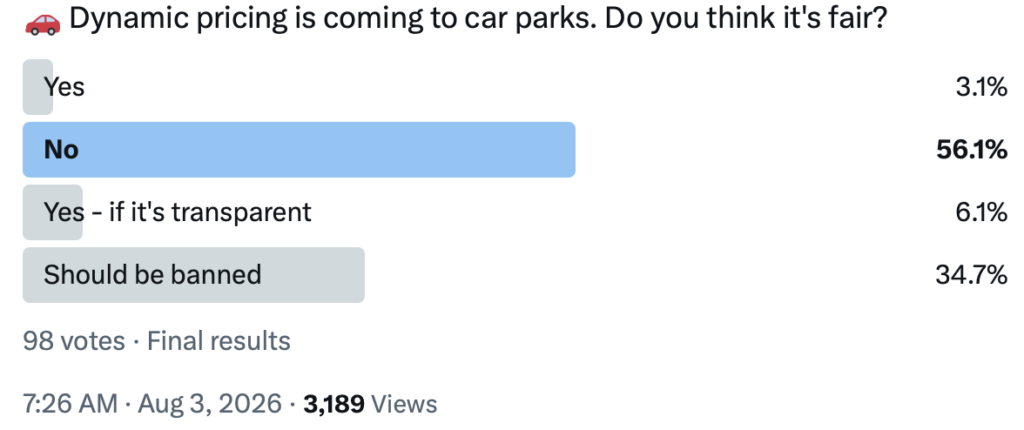
HOW MY FOLLOWERS ON X VOTED
I ran a poll on X (was Twitter) and only 9% voted in favour of it. The vast majority of motorists voted against it, with about 1 in 3 wanting dynamic pricing for car parks banned.
MY VIEW
There’s nothing inherently wrong with dynamic pricing on the face of it, provided it’s transparent.
The problem with dynamic pricing in car parks is that it’s not transparent if the prices are not displayed and you don’t have a smartphone and app. If prices are not clearly displayed at the entrance, many drivers will have no idea what they will be charged.
CONSUMER RIGHTS ACT 2015
The Consumer Rights Act 2015 requires contract terms and notices to be fair and transparent. Consumers must be able to understand the terms they are agreeing to before entering into a contract.
In the context of parking, the tariff is clearly material information. This should be clearly made available to all motorists before they decide whether to park – not restricted to those with smartphones and parking apps.
DIGITAL MARKETS, COMPETITION AND CONSUMERS ACT 2024
The Digital Markets, Competition and Consumers Act 2024 (DMCC Act 2024) has replaced the Consumer Protection from Unfair Trading Regulations 2008. It strengthens consumer protection against unfair commercial practices.
For a practice to be unfair under these rules, it must harm, or be likely to harm, the economic interests of the average consumer. Misleading actions such as providing false or misleading information and omissions are unfair if they are likely to cause the average consumer to take a different transactional decision.
Motorists cannot make an informed decision if they can’t see the tariff before deciding whether to park. Tariffs should be readily available to all motorists – not just those with smartphones and parking apps.
UNINTENDED CONSEQUENCES
Dynamic pricing isn’t the problem – it’s the lack of transparency. If parking operators want to vary tariffs according to demand, they should ensure all motorists can see the tariff clearly before deciding to park.
Motorists risk driving into car parks without realising, find the price is higher than expected and leave.
They risk being unfairly caught out by parking operators issuing Parking Charge Notices (NOT A FINE!) on the basis that a motorist entered and exited without paying, which they are entitled to do under the consideration period.
Private parking operators rely on ANPR camera recording entry and exits to automatically issue Parking Charge Notices demanding up to £100 with a ‘discount’ to £60 if paid within 14 days for an alleged breach of contract for parking on private land.
CONSIDERATION PERIOD
This would breach the consideration period, which allows motorists to enter a car park, read the terms and conditions, consider the tariff and decide whether to accept it or leave. A contract is not formed until a motorist parks up.
The minimum consideration period is usually 5 – 10 minutes (depending on the size of the car park), although parking operators often misinterpret this as the maximum time to coerce motorists into paying their invoices.
I regularly see parking operators flouting consideration periods they are meant to adhere to in the self-authored Single Code of Practice and rejecting legitimate appeals.
The Equality Act 2010 requires all service providers to make ‘reasonable adjustments’. If your condition has a substantial and long-term impact on your ability to carry out normal day-to-day activities, the law is on your side. This can be used when appealing an unfair Parking Charge Notice (invoice).
You can see why the private parking ‘industry’ is so enthusiastic about it! Most car journeys end in a car park.
What do you think of dynamic pricing in car parks? Do you think it’s fair or a rip-off?
