

Parking tickets can be stressful for anyone, but for people with disabilities or long-term health conditions, they can also be deeply unfair. What many don’t realise is that the Equality Act 2010 offers powerful legal protections that can help you fight back.
I explain in this post how you can use the Equality Act 2010 to challenge unfair parking tickets, particularly if you are classed as vulnerable.
Why the Equality Act 2010 matters in everyday consumer disputes
The Equality Act 2010 legally protects people from discrimination in the workplace and wider society. It places an obligation on businesses to make provisions relating to transport for disabled persons and make reasonable adjustments.
There are nine protected characteristics, although my focus for this topic is age and disability.
Councils and private parking operators simply do not care about how their actions disproportionately affect vulnerable people.
Situations in which you are protected from discrimination
You are protected from discrimination under the Equality Act 2010:
- When you use businesses and other organisations that provide services and goods (shops, restaurants, cinemas, gyms etc)
- When you use transport
Direct discrimination means treating one person worse than another because of a protected characteristic.
Indirect discrimination is when an organisation creates rules and policies that have a worse impact on those with a protected characteristic. It also occurs where a provision or criteria is applied which is discriminatory to those with a protected characteristic.
Designing rules and regulations that work against elderly people could be classed as indirect discrimination.
Parking meters need to be easily accessible for those with disabilities. By making pay to park app only, this is discriminatory to those who do not have smartphones and are not familiar with modern technology.
Definition of disability under the Equality Act 2010
The UK Government defines disability under the Equality Act 2010 as follows:
“You’re disabled under the Equality Act 2010 if you have a physical or mental impairment that has a ‘substantial’ and ‘long-term’ negative effect on your ability to do normal daily activities.”
What ‘substantial’ and ‘long-term’ mean
- ‘substantial’ is more than minor or trivial, for example it takes much longer than it usually would to complete a daily task like getting dressed
- ‘long-term’ means 12 months or more, for example a breathing condition that develops as a result of a lung infection
Who Counts as Vulnerable Under the Equality Act 2010?
Vulnerability has a broad spectrum, and anyone can find themselves vulnerable at some point in their lives through no fault of their own.
The relentless move towards doing everything off our smartphones with apps is alienating the most vulnerable and elderly consumers in society. 8.5 million people in the UK lack the most basic digital skills, according to Good Things Foundation.
Not all disabilities are visible. It’s estimated that over 10 million people have arthritis or related joint conditions, according to the British Nutrition Foundation. Arthritis can be classed as a disability under the Equality Act 2010, depending on the severity and duration of the impact on daily life.
The Equality Act 2010 protects people from discrimination due to a “protected characteristic.” One of these is disability. This includes visible physical impairments, mental health conditions, neurodivergence (such as autism or ADHD), chronic illnesses, arthritis and more.
MS, ME / Chronic Fatigue Syndrome, Long Covid and cancer are also recognised medical conditions that are classed as disabilities.
These can all be used as part of an appeals process.
If your condition has a substantial and long-term impact on your ability to carry out normal day-to-day activities, the law is on your side.
The Equality Act 2010 – Protected Characteristics
Chapter 1 of the Equality Act 2010 defines and covers nine different Protected Characteristics.
Paragraph 6 covers Disability and states:
(1) A person (P) has a disability if—
(a) P has a physical or mental impairment, and
(b) the impairment has a substantial and long-term adverse effect on P’s ability to carry out normal day-to-day activities.
(2) A reference to a disabled person is a reference to a person who has a disability.
(3) In relation to the protected characteristic of disability—
(a) a reference to a person who has a particular protected characteristic is a reference to a person who has a particular disability;
(b) a reference to persons who share a protected characteristic is a reference to persons who have the same disability.
What Does the Equality Act 2010 Require?
Chapter 2 of the Equality Act 2010 covers Prohibited Conduct and Part 3 covers Services and Public Functions.
Sections 20 and 29 of the Equality Act 2010 are crucial within the context of parking disputes.
- Section 20: Duty to make adjustments
Organisations must make reasonable adjustments for disabled people. - Section 29: Provision of services, etc
Service providers (including private parking operators and councils) must not discriminate against disabled people.
Common Scenarios Where the Equality Act 2010 Applies
Mobility issues or chronic fatigue meant that it took you longer to return to your vehicle.
You have a passenger who is a wheelchair user and it takes time to get in and out of a vehicle, meaning you were not able to comply with the strict time conditions of the car park.
You may have cognitive or neurological impairment which can be proved and could directly be linked to difficulties in reading signs. I would be wary of using this in an appeal, as it could be argued that the DVLA ought to be informed of this medical condition.
A medical appointment overrunning due to a condition which is captured as a disability, meaning that the GP needed to spend more time with you.
The scope is vast. If you can directly link your medical condition or disability to what you consider to be an unfair parking ticket, you have good grounds to appeal it.
How to Challenge a Parking Ticket Using the Equality Act 2010
Evidence is key with all complaints, especially parking tickets.
- Request Reasonable Adjustments
- Ask for the parking ticket to be waived or cancelled due to your condition.
- Make clear this is a request under the Equality Act 2010.
- Provide Supporting Evidence
- Supply a letter from your GP, consultant or support worker.
- Explain how your condition affects your ability to comply with parking rules.
- Use the Right Language
- Be assertive but polite.
State clearly: “You are under a legal duty to make reasonable adjustments under Section 20 of the Equality Act 2010.”
- Be assertive but polite.
- Escalate If Necessary
- If your appeal is rejected and your evidence is ignored, contact:
- Equality Advisory and Support Service (EASS)
- Your local councillor or MP
- Local Government Ombudsman (for council tickets)
- Most private parking operators are a member of the British Parking Association (BPA) or International Parking Community (IPC).
Parking On Private Land Appeals (POPLA) is the second-stage appeal to contest Parking Charge Notices for BPA members.
Independent Appeals Service (IAS) is the second-stage appeal to contest Parking Charge Notices for IPC members.
- If your appeal is rejected and your evidence is ignored, contact:
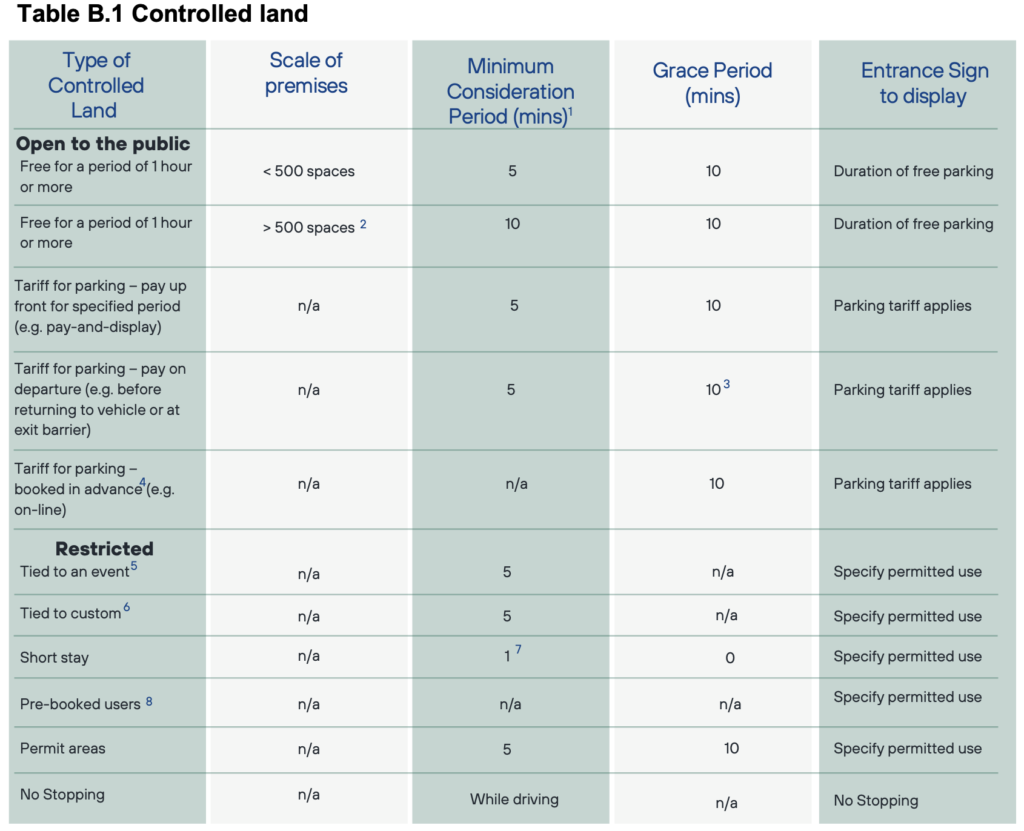
Consideration and grace periods
When you enter a car park, you are given a consideration period to give you an opportunity to read the signs, terms and conditions and either stay or leave. A contract is not formed during this time.
A grace period is the time allowed to leave after your parking time expires.
Parking operators usually misinterpret the ‘minimum’ as ‘maximum’. There’s nothing there that says ‘maximum’, where the Equality Act 2010 (for example), allows for reasonable adjustments to be made.
I regularly see consideration and grace periods flouted by private parking operators on first-stage appeals. That’s their business model.
If you get a Parking Charge Notice for running slightly over time due to your disability, appeal it. You don’t need to pay their invoice (not a fine).
Real-Life Example
Someone turned to me for help after Manchester City Council rejected her parking ticket appeal twice, even though she had made it clear and submitted evidence that she had only stopped to allow a very sick passenger with incurable advanced bowel cancer to use the public toilets.
Signs nearby were also hidden by foliage, although that was a sideshow from the main crux of the complaint and appeal.
She was left shocked at how harsh and uncaring the council were, but felt she had no choice but to pay it. Luckily, she heard me talking about unfair parking charges on BBC Radio Manchester and contacted me.
I immediately replied and said legally under the Equality Act 2010, the appeal should have been allowed. I suggested she escalated it to the Chief Executive of Manchester City Council and copy in Andy Burnham (Mayor), as the council’s position was unlawful. I also said that the staff who insist it needed to be paid should be subject to disciplinary action.
The ticket was eventually cancelled.
Finally
A private parking operator CANNOT fine you. They issue invoices called Parking Charge Notices for an alleged breach of contract for parking on private land.
The easiest way to cancel them is to speak to the landowner. So, if you got a Parking Charge Notice at Lidl, speak nicely to customer services with your receipt and ask they cancel it.
If you got a Parking Charge Notice at a small retail park, gym or pub, ask them to cancel it for you.
Always get proof or confirmation they will cancel it in writing. Verbal confirmations mean nothing.
Councils issue fines called Penalty Charge Notices. The appeals process is usually much fairer and straightforward, but don’t be afraid to challenge an unfair parking ticket.
If you are vulnerable or disabled, don’t let automated systems and red tape prevent you from asserting your rights. The Equality Act 2010 is a powerful tool. Use it.
Have you had any similar experiences? What are your thoughts on this? Feel free to share your stories or ask questions in the comments.

My partner, who suffered a severe stroke in 2024, deals with cognitive issues and anxiety, as well as mobility problems. While I was away on holiday, he went to do a little shopping at a retail park where parking is free for Blue Badge holders. Because of his condition, he forgot to display his Blue Badge, and two weeks later he received a parking charge.
I appealed on his behalf and provided them with a copy of his Blue Badge, a hospital letter, and a letter from his GP confirming his medical condition. However, they rejected the appeal without making any reasonable adjustments. They even acknowledged that he is a valid Blue Badge holder and was entitled to park there, but they still fined him simply because his disability caused him to forget to display it.
I have now appealed to the IAS and am waiting for an outcome. I also contacted our local MP, who has sent a letter to the parking company on our behalf.
If he didn’t have me to support him, my partner would have just paid the fine out of fear. It feels so unlawful that these companies take advantage of disabled people – relying on the fact that they won’t challenge the charges – just to turn a profit.
I think I have taken all the right steps to challenge them so far.
Hi I am disabled with my autistic daughter parked in free retail private parking with 3hours max stay .due our situation we over stayed 15 minutes . No I don’t konw what should I do .I need some advice.
Please help me
Thank you
Thank you this is really helpful! Reading your description of indirect discrimination, do you think companies requiring blue badge holders to register at customer service in order to avoid NPR fines is indirect discrimination? It’s an extra thing to have to do that non-disabled people don’t have to do. And it might sound simple but it’s an extra thing to remember which is difficult with brain fog, low mental energy and ADHD especially when I’m already navigating an overstimulating environment, with mobility aids. I think parking companies should think of a different way to ascertain who is disabled that doesn’t put the burden on the disabled person (and I can think of many).
On holiday for the first time in Newlyn Cornwall I drove into a parking with ANPR cameras. Having waited 10 mins to park I eventually parked and then went to view the conditions of the parking. I have quite severe mobility issues and alone took about 8 mins to walk to the pay station. Deciding the parking was not for me I walked back and left. The total time was 30 mins. I have a blue Badge and higher PIP due to spinal injuries from Sepsis. I was issued a ticket and appealed providing them with an explanation of the slowness of my attempt to read the conditions. This they rejected. and have gone to the IAS appeal. I believe strongly that they are discriminating against me under the equalities act simply because I cannot walk as fast as an able bodied person. If the consideration period is 10 mins it would easily take me 3 times that time. But I cannot find case law can you help ?