

Are you wondering how to save fuel as petrol and diesel prices soar? These five simple changes could save motorists up to £500 a year.
The UK Government has introduced a Fuel Finder service to make it easier for motorists to compare live fuel prices across the UK and shop around the for the best deal.
Fuel retailers must submit price updates within 30 minutes of any change.
FUEL DUTY
Duty has been frozen for more than a decade. The Social Market Foundation said in March 2024 it’s estimated to have cost nearly £130bn.
Fuel duty was cut by 1p in 2011 to 57.95p per litre and frozen since. A temporary 5p a litre cut was introduced in March 2022 in response to rising fuel prices.
In May 2026, amid rising fuel prices following the Iran conflict, the Government extended the temporary 5p cut until 31 December 2026
Fuel duty on petrol and diesel therefore remains at 52.95p per litre. The Government is expected to confirm what happens next at Budget 2026.
VOLATILE PRICES
The Iran conflict and ongoing uncertainty have sent fuel prices soaring.
Fuel prices were at a three-year low, with the average price of unleaded fuel at 135.26p and diesel at 140.26p a litre as at 28/10/2024 according to RAC Fuel Watch.
This has shot up to an average of 167.72p for unleaded and 189.28p for diesel as at 14/09/2026.
The average motorist drives 6,550 miles a year according to ByMiles and the average car does 38.8mpg (or 8.54 miles per litre) according to Nimblefins.
This means the average motorist uses about 767 litres of fuel a year and was spending approx. £1,037 on unleaded and £1,076 on diesel in October 2024.
Motorists are now spending approx. £1,286 on unleaded fuel and £1,452 on diesel as at 14/09/2026 – an extra £250 a year for unleaded and £376 a year for diesel.
Although we cannot control fuel duty hikes, we can control how much fuel we use.
With household budgets being squeezed with no end in sight, a few simple tweaks can make a difference.
USE AN APP TO FIND THE CHEAPEST FUEL PRICES
Petrol prices vary widely across the UK and even short distances. The latest figures show motorists can save around 18p – 22p a litre by avoiding motorway service stations and finding cheaper stations nearby.
The two RAC Fuel Watch snapshots below, taken just six weeks apart, show how quickly prices have been moving.
This snapshot was taken on 05/08/2026.

This snapshot was taken on 14/09/2026.
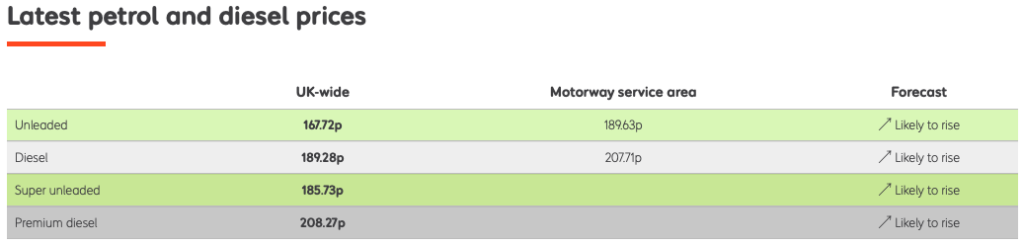
You don’t have to drive around to find the cheapest fuel.
The website www.petrolprices.com and www.rac.co.uk/drive/advice/fuel-watch have apps you can download to find the cheapest fuel near you.
A small car has a 40-litre tank and a family car holds up to 70 litres, which means you can save around £7.50 – £15 every time you fill up by avoiding motorway fuel stations.
Motorway fuel is typically 18p – 22p a litre more expensive than off-motorway forecourts.
Based on the average UK driver using around 767 litres of fuel, shopping around could save you around £140 – £170 a year.
Saving – approx. £140 – £170 a year
KEEP YOUR SPEED DOWN
The AA say reducing your speed can significantly improve fuel economy.
If you drive at 70mph, you will use up to 9% more fuel than you would at 60mph and up to 15% more than at 50mph.
Based on current fuel prices and annual consumption of around 767 litres, cutting your speed from 70mph to 60mph could save around £105 a year for a petrol car and £120 a year for a diesel.
Saving – up to approx. £105 – £120 a year
JUNK THE TRUNK
Have a look in your boot. Every extra 50kg in your car costs an extra 2% in fuel according to the RAC.
At current prices, 2% of the average motorist’s annual fuel consumption is worth around £26 – £29.
Saving – approx. £25 – £30 a year
CHECK YOUR TYRES
Properly inflated tyres are not only essential for road safety, but can save you money.
This is because properly inflated tyres have lower rolling resistance, meaning your engine requires less effort and fuel.
Tyres generally lose up to two pounds per square inch (psi) of air per month according to Kwik-Fit.
Underinflated tyres wear out faster.
A 6psi reduction in recommended air pressure adds 3% to fuel consumption according to TyreSafe.
At today’s prices, 3% of average annual fuel consumption costs around £39 for petrol and £44 for diesel.
Saving – approx. £40 – £45 a year
REMOVE THE ROOF RACK
If you are not using your roof rack or storage box, remove and store it.
Roof racks and storage boxes can seriously affect a vehicle’s aerodynamics and increase drag, leading to increased fuel consumption.
Removing roof rack crossbars can improve your fuel economy by up to 12%, although the actual saving will vary depending on the vehicle and how it is driven.
At current fuel prices, a 12% fuel saving would be worth around £155 for petrol and £175 for diesel.
Saving – up to approx. £175 a year
ADDITIONAL FUEL SAVING TIPS
Drive smoothly
Harsh acceleration and braking waste fuel. Looking ahead, accelerating gently and maintaining a steady speed can improve fuel economy.
At current prices, reducing your fuel consumption by 5 – 10% could save the average motorist around £65 – £145 a year, depending on whether they drive a petrol or diesel car.
Saving – potentially £65 – £145 a year
Avoid unnecessary idling
Leaving your engine running while waiting wastes fuel.
Combine journeys
Plan ahead and use your car for several trips instead of ad-hoc short trips on a cold engine.
There are many easy ways to save money on running a car by doing simple jobs yourself – I save up to £300 a year by doing so.
These simple changes could potentially save you around £400 – £500 a year on fuel. Those who drive more miles or regularly use motorway fuel stations could save even more.
Can you add any more tips?
