

Analysis conducted by the RAC and Channel 4 Dispatches – The War on Britain’s Motorists (Channel 4, Thursday 23rd May at 8pm) has found local authorities are taking wildly differing approaches to deciding whether or not potholes get fixed, meaning many go unrepaired and continue to pose a risk to road users – especially those on two wheels.
Three-in-10 of the 206 councils in Great Britain with responsibility for roads (29%, or 59) don’t state any criteria publicly online for repairing potholes. Just over a third (35%) list specific depths, and in some cases widths, and 37% (76 councils) say they take a ‘risk-based approach’ to deciding which potholes to fix and how quickly.
This means members of the public who proactively report potholes to local authorities with a view to getting them repaired may often be left frustrated when no action is taken and potholes are simply left to get bigger in order to merit repair.
The RAC said owners can expect to pay up to £460 for pothole-related repairs.

Among the 35% of councils (71) that say they will only act on potholes if they meet certain criteria, the most common depth stated is 4cm (54 councils).
Six councils – Warwickshire, Torbay, Thurrock, Nottingham, Torfaen and South Lanarkshire – potholes need to be at least 5cm deep to be considered for repair.
Thirteen local authorities including Buckinghamshire, Stockport and Devon, state only those at least 30cm wide – the length of an A4 sheet of paper – and 4cm deep will get fixed.
While three-in-10 councils (29%) don’t provide criteria on their website for what constitutes a pothole they will fix, even the 37% which take risk-based approaches don’t often provide much information to explain how this works.
The RAC observed there is no consistency. For example, it found East Riding Council, which uses a risk-based approach to repairing road defects, positively explains that it inspects all reported potholes within 24 hours, fixing the most urgent within the same timeframe, and then clearly sets out how it prioritises repairing the rest.
In complete contrast, Redcar and Cleveland Council does not appear to have a single page on its website even referencing potholes, nor an ability for people to report them online.
The RAC is now calling on:
- The Government to instruct councils to take a risk-based approach to deciding when road defects need attention. New guidance should include criteria councils must use when assessing potholes – including how busy a road is, and how commonly it is used by cyclists – and recognise that just because a pothole may not meet certain depth and width measurements, it may nonetheless represent a hazard to road users
- Local authorities, if they are not already doing so, to publish the following on their websites that can be easily found by anyone reporting a pothole:
- The criteria used for assessing reported potholes to decide how soon they are fixed
- What happens once a member of the public has reported a pothole, including how soon the road in question is assessed
- A phone number for reporting potholes that the public deem to be emergencies
Pothole related breakdowns in numbers
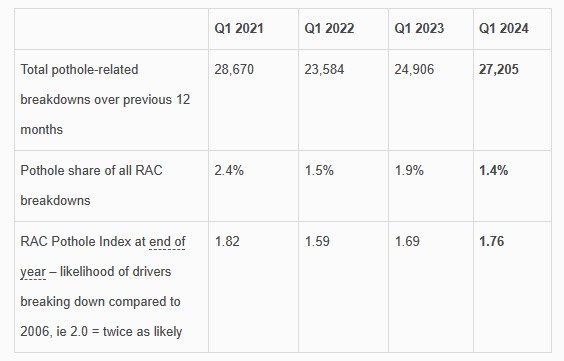
Potholes and a risk-based approach
Knowing how to claim for pothole damage is becoming increasingly difficult due to Councils moving to a risk-based approach on claims.
This is nothing new. Local authorities have quietly switched to a ‘risk based approach’ over the past 3 years or so to make it more difficult for motorists to seek compensation for pothole damage.
The previous policies were also “risk-based” but they defined exactly (dimensions) which potholes should be fixed. Councils used to have policies which specified exactly that if a pothole was x mm deep it would be fixed. That made it an objective decision for staff.
The new policies are also “risk-based” but do not define dimensions of potholes. Two identical potholes can be treated differently by different staff due to “judgement”. Two identical potholes can be treated differently at different locations due to different “risk” on different roads.
Now staff have to consider a variety of “factors” (without any specific mention of depth dimensions). This results in subjective decisions being made meaning one Inspector may choose to instruct a repair when another would not. Councils have made what was a black and white decision into a grey area for their own benefit to deny claims.
RAC spokesperson Rod Dennis said:
“For a long time, we’ve advised the public to report each and every pothole they come across to their local authority, not least as a council can refuse to compensate for damage caused from hitting one if they can prove they didn’t know it existed. But unfortunately, as this analysis shows, just reporting a road defect doesn’t guarantee it will get fixed.
“In some cases, councils state a pothole needs to be sufficiently deep or wide to be considered for repair. This can be enormously frustrating for anyone who comes across one, reports it but then witnesses it get even bigger and more dangerous as it didn’t quite reach a council’s threshold for repair.
“What’s just as bad is when a council provides no information whatsoever on how they decide which road defects warrant their attention and which don’t. In these cases, drivers going to the effort of reporting potholes have no idea at all whether anything will ever happen.
“There’s no doubting councils are in an incredibly difficult position when it comes to looking after their roads. Despite the promise of more funds from central government, the fact remains that the desperate state of many of the country’s highways is something that has been many years in the making, and there are no quick fixes.
“We believe there is an urgent need for Whitehall to provide fresh guidance to councils to bring about consistency when it comes to prioritising potholes and taking action to fix them. We’re also concerned about reports that some councils are refusing compensation claims from drivers who have damaged their cars from potholes, by stating they already have them scheduled for repair – even if that repair isn’t due for months.”
How drivers can highlight pothole epidemic
“Drivers frustrated by the UK’s pothole epidemic can highlight the problem by downloading and using Stan, a new free mobile app capable of automatically detecting road defects via a smartphone camera mounted in a cradle. The data is helping build the UK’s first ever national map of road surface issues. The RAC is urging local authorities to use the data to locate problems on their networks and carry out repairs quickly and efficiently.”
Download Stan on the App Store and Google Play.
Dave Gaster, Invented Lean and Systems Thinking Developed Visualising Transformation, said:
“S58 of The Highways Act 1980 (not Scotland) says if a Council should be aware of the issues, it has a duty to act, with Stan. Plus Fix My Street they DO KNOW where the issues are. Zero defence.”
HOW TO CLAIM FOR POTHOLE DAMAGE
REPORT IT
If you hit a pothole and you believe it has damaged your vehicle, you need to report it as soon as possible. You can do this via www.fixmystreet.com or www.fillthathole.org.uk or simply contact the local authority direct by phone or via Twitter / X.
TAKE PHOTOS
Take photos if possible to evidence your claim. If it is safe to do so, put your foot by the pothole or in it for scale. I would suggest measuring it as well but nobody carries a ruler for such events, hence suggesting this.
PROVIDE A SKETCH WITH YOUR CLAIM TO PINPOINT THE POTHOLE
You will be asked to help the local authority find the pothole as there are that many on the roads. A simple sketch will suffice.
GET AN ESTIMATE FOR COST OF REPAIRS / PROVIDE A COPY RECEIPT
You are seeking a full refund for the damage caused due to the negligence of the local authority. Include this in your claim from the outset.
SUBMIT AN EIR / FOI REQUEST
Ask for 12 months’ worth of inspection reports and how many times this pothole has been reported. When was the last repair made? Was it reported before you hit it? You can also find out how many times it has been reported via www.fixmystreet.com and www.fillthathole.org.uk.
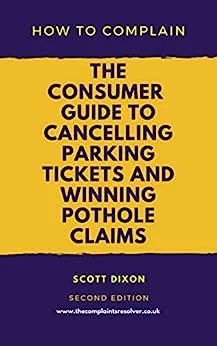
This is just the start of the process. You can find out more in my book “How to Complain: The Consumer Guide to Cancelling Parking Tickets and Winning Pothole Claims”.
Pothole related claims – My View
Every local authority has a statutory responsibility to inspect roads to a set timescale and ensure roads are fit for purpose.
Potholes do not form overnight. It is clear to me and most motorists that inspectors are missing a lot of potholes. Many roads are not fit for purpose and represent a danger to life for vulnerable cyclists and motorcyclists.
A move to a risk-based approach on road inspections has resulted in repairs being neglected. Cutbacks are often cited, yet motorists are paying more than ever to use third-world roads.
If potholes were repaired properly, there would be more money available to repair more potholes.
Motorists pay Vehicle Excise Duty (VED), insurance, 12% tax on insurance policies, 20% VAT on tyres and pothole related damage. Motorists are forced to claim on their insurance because local authorities make it nigh on impossible to lodge a claim.
It is a gross injustice and totally unfair. Motorists should be able to drive on roads without having to constantly dodge potholes and risk pothole related breakdowns.
Finally
We are in a state of managed decline. Throwing money at patching and potholes does not provide the best value for money. We need a national roads renewal programme.
Knowing how to claim for pothole damage is more difficult than ever.
Have you suffered pothole-related damage to your vehicle? Did you try and claim against the local authority instead of your insurance policy?
