

The cost of repairing roads in England and Wales has soared to nearly £17 billion and will take 12 years, according to the latest industry report.
The Annual Local Authority Road Maintenance (ALARM) 2025 survey reports that roads in England and Wales are only resurfaced, on average, once every 93 years.
The figures, from this year’s Annual Local Authority Road Maintenance (ALARM) survey report, spell more misery for road users with one in every six miles of the local road network equivalent to 34,600 miles – reported to have less than five years’ structural life remaining.
The AIA are calling for a complete change in mindset away from short-term funding to longer-term commitments to allow local authorities to proactively improve the network.
Key Statistics
Other key statistics include:
- 48% of the local road network in England and Wales is reported to be in good structural condition (15 or more years of life remaining)
This is up 1% from 47% in 2023/24 and below 51% in 2022/23 and 55% in 2021/22 - 15% of roads in England and 16% of roads in Wales has less than 5 years remaining
- The average number of claims received by local authorities in England and Wales has decreased by 2.6% to 410 per authority (2023/24: 421 per authority)
92% related specifically to potholes
(2023/24: 89%) - Compensation claims paid out by local authorities is up by 30% to £19.7 million
A further £17.6 million was spent on staff costs to deal with pothole claims
The total spent on compensation claims is £37.3 million across England, London and Wales – up 32% on last year (2023/24: 28.2 million) - The cost of clearing the pothole repair backlog has reached a record high of £16.81 billion
- It would take 12 years for local authorities to repair every crumbling road in England and Wales
(2023/24: 10 years) - Roads are only resurfaced on average once every 93 years
(2023/24: 80 years)
This breaks down as once every 103 years for all roads in England, 44 years in London and 108 years in Wales - 1.9m potholes were repaired last year – down approx. 100,000 from 2m in 2023/24.
In the last decade more than £1.08 billion has been spent filling 17.5 million potholes – equivalent to one pothole repaired every 18 seconds, every day, for 10 years. - Utility companies opening a road to create a trench can reduce its structural life by an average of 17%
84% are completed in accordance with legislation (up 2% in 2023/24)
Local authorities spend an average of 2.8% of their carriageway maintenance budget repairing trenches (was 3.9% in 2023/24)
This totals £66.8m in England and Wales – more than £395,000 per authority
In 2023/24 it was £91.7m in England and Wales – more than £542,000 per authority
Highway engineers agree that the number of utility openings reduce the life of the carriageway.
POTHOLES AFFECT EVERYONE AND ARE DETRIMENTAL TO THE ECONOMY
David Giles, Chair of the Asphalt Industry Alliance (AIA), which commissions the ALARM survey, said:
“Over £20 billion has been spent on carriageway maintenance in England and Wales over the last decade.
“However, due to the short-term allocation of this funding, it has resulted in no quantifiable uplift in the condition and resilience of the network.
“In fact almost all (94%) local authority highway teams reported that, in their opinion, there has been no improvement to their local network over the last year: a view no doubt shared by the majority of road users.”
“There needs to be a complete change in mindset away from short-term to longer term funding commitments,” added David Giles.
“Local authorities do their best with the resources available. Nevertheless, they have told us they need their budgets to more than double for the next five to 10 years if they are going to be able to address the backlog of repairs.
“That is why we are calling on Government, particularly now with a Comprehensive Spending Review ahead, to set a minimum five-year funding horizon and a substantial, sustained increase in investment with budgets ring-fenced specifically for local roads maintenance.
“Investing to save in local roads would allow authorities to plan and provide better value for money for taxpayers and deliver a more resilient network while helping kickstart the Government’s economic growth plans.”
RAC Head of Policy, Simon Williams, said:
“Once again, these figures paint a bleak picture of the state of the nation’s roads and confirm what a majority of drivers have known for a long time – that in far too many parts of the country, road surfaces are simply not fit for purpose.”
“The lack of investment in our roads is a false economy as it just leads to bigger repair costs in the future – something local authorities can ill-afford. In the meantime, all road users continue to pay the price with uncomfortable journeys, avoidable breakdowns and repair bills that they only incur because potholes are so bad.
“We’re committed to working closely with the road maintenance sector, including the AIA, to get the message to government that councils need to have certainty of resources to look after one of their most valuable assets – the roads millions of us use every day.”
Local Government Association Transport Spokesperson, Cllr Adam Hug:
“It is no surprise to councils that the local roads repair backlog continues to rise, given inflation and huge demand pressures on local government statutory services.
“The funding increase in the last Budget was positive and must now be followed by a commitment in the Spending Review to a long-term financial package to tackle this backlog and put it into reverse.
“Investing in local roads now makes them more resilient and last longer, with direct benefits to road users, business, wider society and the environment.
“Councils have long called for a five-year funded package for maintaining our local roads, ensuring they are treated on a par with our motorways and major trunk roads, which is supported by this latest report.”
IAM RoadSmart Director of Policy and Standards, Nicholas Lyes:
“The AIA’s report lays bare the inadequate repairs happening on our local roads, where despite spending billions on filling potholes, the backlog costs are increasing.
“Potholes are an expensive headache for drivers but for those on two wheels they pose a serious road safety hazard. Moreover, if drivers are swerving to avoid them, they are risking a collision. While filling a pothole provides temporary respite and a brief improvement in the safety of the road surface, it is essentially a sticking plaster because the section will crumble away under the weight of traffic and from the effects of a cold winter. We need to start properly resurfacing our roads to ensure we’re not throwing good money at bad roads, but most importantly to ensure smooth and safe journeys.”
Institute of Highway Engineers Chief Executive, Lyle Andrew:
“This year’s ALARM findings continue to highlight the ongoing challenges faced in maintaining the local road network. Budget cuts of 4.1% in real terms, has led to the continuing deterioration of what is our most valuable asset.
“Short-term funding allocations have failed to provide the necessary improvements required to uphold network resilience. It is clear that the only viable option is long-term investment in order for local authorities to carry out essential works to the local roads.
“With the spending review set to conclude this spring, the reported £16.8 billion one-off payment would take 12 years to complete, to adequately prevent further deterioration of the road network and aid in a solution to the growing pothole issue. However, with 52% of local roads now having less than 15 years’ structural life remaining, this continued shortfall in funding risks worsening surface failures and network decline.”
WHO PAYS FOR DAMAGE CAUSED BY POTHOLES?
We all do via the Insurance Premium Tax which is levied on car insurance policies, Council Taxes, vehicle excise duty, tax paid on fuel (with 20% VAT on top), car parking permits and other levies.
Councils have a statutory duty to maintain and inspect the roads to a satisfactory standard. Councils collude with claims stoppers to prevent you from upholding a legitimate claim. Proving it is difficult but not impossible.
You will be encouraged to claim on your car insurance policy. Why should you be left out of pocket due to their negligence?
WHAT PROBLEMS DO POTHOLES CAUSE?
Hitting a pothole can cause damage to your vehicles shock absorbers and suspension. Broken springs are the most common damage. Burst tyres and damaged alloys are another hazard which can cause a driver to lose control of their car.
Potholes are also a hazard to cyclists and motorcyclists who risk serious injuries or even death, especially at night.
HOW DO YOU KNOW IF A POTHOLE DAMAGED YOUR CAR?
Steering pulling to the left / right and uneven tyre wear is a sign that the tracking alignment is out and needs resetting by a tyre garage.
Dents on the wheels and bulges on tyre sidewalls are also a sign.
Listen to the suspension. Is it ‘clunky’? Does it thump when you are driving? That could be a sign of a broken spring.
BACKGROUND
An interesting case in May 2017 in the Isle of Man shone a spotlight on local authorities only being liable if a pothole is reported but not fixed.
This case was aired on Manx Radio where someone tried to claim for pothole damage that wrote off their car (it must have been some pothole!)
CLAIMS HANDLERS
The default position that every Highway Authority and claims handlers will take is that they can only be held liable for potholes that have been reported and cannot be held responsible for every pothole on the roads. They won in this instance. This is known as the Section 58 defence in the Highways Act 1980 which local authorities try and hide behind.
Whilst this stance may hold water on the face of it, in reality, local authorities have a statutory duty of care to maintain the roads and inspect them regularly. When was that road last inspected?
Claims handlers work in cahoots with local authorities to reject legitimate pothole claims. That is their sole purpose – they are not independent arbitrators. They work from scripts and default answers to reject claims and hope that you give up on the first attempt. Most people unfortunately do, but once in a while someone like me comes along and tackles them head on.
DEFAULT RESPONSES USED TO DECLINE POTHOLE CLAIMS
Claims handlers use the following responses to decline pothole claims.
- No reports received about the defect before the incident.
- There was no defect outwith criteria at the location on the inspection before the incident.
- A repair was carried out once the defect was reported but unfortunately this was after the incident.
This is the first obstacle you will be faced with. Claims handlers use these responses knowing that the majority of claimants will simply give up.
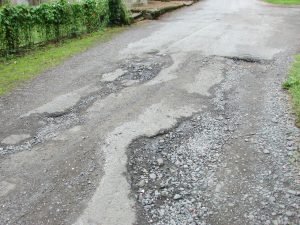
HOW TO CLAIM FOR POTHOLE DAMAGE
Knowing how to claim for pothole damage is becoming increasingly difficult due to Councils moving to a risk-based approach on claims.
Councils used to have policies which specified exactly that if a pothole was x mm deep it would be fixed. That made it an objective decision for staff.
Now staff have to consider a variety of “factors” (without any specific mention of depth dimensions). This results in subjective decisions being made meaning one Inspector may choose to instruct a repair when another would not. Councils have made what was a black and white decision into a grey area for their own benefit to deny claims.
REPORT IT
If you hit a pothole and you believe it has damaged your vehicle, you need to report it as soon as possible. You can do this via www.fixmystreet.com or www.fillthathole.org.uk or simply contact the local authority direct by phone or via Twitter.
TAKE PHOTOS
Take photos if possible to evidence your claim. If it is safe to do so, put your foot by the pothole or in it for scale. I would suggest measuring it as well but nobody carries a ruler for such events, hence suggesting this.
PROVIDE A SKETCH WITH YOUR CLAIM TO PINPOINT THE POTHOLE
You will be asked to help the local authority find the pothole as there are that many on the roads. A simple sketch will suffice.
GET AN ESTIMATE FOR COST OF REPAIRS / PROVIDE A COPY RECEIPT
You are seeking a full refund for the damage caused due to the negligence of the local authority. Include this in your claim from the outset.
SUBMIT AN EIR / FOI REQUEST
Ask for 12 months worth of inspection reports and how many times this pothole has been reported. When was the last repair made? Was it reported before you hit it?
You can also find out how many times it has been reported via www.fixmystreet.com and www.fillthathole.org.uk.
£1100 POTHOLE CLAIM
I took Fife Council to Court on a pothole claim which was reported in the Dunfermline Press. The claims handlers said that Fife Council has a reasonable inspection and maintenance system – I didn’t believe it. Let’s see the proof via a Freedom of Information request.
A Category 1 repair is most serious. A Category 2 repair is significant and indicates that vehicle damage could occur.
The council is legally responsible for keeping the road network maintained and they are paid by local taxpayers to do so.
In this case (and most of the time) they have clearly failed in their duty. They admitted there was a pothole and they failed to repair it within the statutory timeframe.
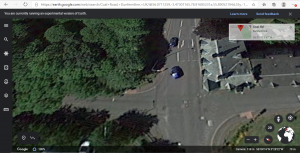
I found it from space on Google Earth and on Google Street Maps, yet Fife Council needed my help to find it on a map despite repairing it days later.
Google Street Maps has a date stamp, so it’s clear to me that this pothole has been a problem hotspot for years. That in itself supports a Freedom of Information request and questions asked.

CRITERIA
Every local authority has a statutory responsibility to inspect the roads on a set timescale and ensure that the roads are fit for purpose.
If, after a pothole has been reported and it has been remedied within days, it can clearly be argued that the pothole was dangerous and the road was not fit for purpose at the time it was reported and the damage caused.
Local authorities have to adhere to a specific criteria for inspections and repairs.
LIABILITY
The authority has demonstrated liability because they have taken the time and trouble to repair it straight away to prevent any further claims or injuries. If they were not liable, why would they bother dealing with it?
RETROSPECTIVE POTHOLE CLAIMS
I know individuals who have lodged claims for pothole damage to their cars based on failed MOT reports for broken springs that have cost over £200 to replace. They have simply picked out a pothole, reported it and retrospectively lodged a claim. It’s easy to do (although I could not condone it myself).
You can reopen a pothole claim and appeal it. You have up to 6 years in England and Wales and 5 years in Scotland via the Small Claim Court.
APPEAL IT
Lodge an appeal with the Council. Submit a Freedom of Information request asking the right questions to blow their case apart.
SMALL CLAIMS COURT
The Small Claims Court is always a last resort, but don’t be afraid to use it. I took Honda to Court for a rejected warranty claim and they settled it within 1 hour of receiving the Court papers.
Pothole claims are one of my specialities.
You had a 10% chance with Fife Council. I lodged a Freedom of Information request asking for the statistics.
This is now 1% with Fife Council, which is completely unacceptable.
FINALLY
We are in a state of managed decline. Throwing money at patching and potholes does not provide the best value for money. We need a national roads renewal programme.
Local authorities do not do their best with the resources available. I proved that with a £3,500 pothole repair, where Edinburgh City Council made a weekend out of one repair!
If local authorities repaired potholes properly to the correct specification and criteria, more money would be available for more repairs.
Utility trench repairs also need to be monitored and checked by local authorities and costs recharged.
Knowing how to claim for pothole damage is more difficult than ever.
Do you know how to claim for pothole damage to your car? Have you been able to successfully win a claim for pothole damage?

Great article yet again Scott and very informative Thanks fir the information.